In the previous article, we saw how an Artificial Intelligence agent (AI Agents) can use tools and reason to solve tasks autonomously. But what happens when the problem is too large or complex for a single agent? This is where Multi-Agent Systems (MAS) come into play.
A Multi-Agent System is a network of specialized agents that collaborate with each other, as if they were a team of professionals where each one has their own role. Instead of having an “all-purpose agent,” we have several agents that divide the work among themselves, coordinated by a supervisor agent, to solve problems in a more efficient and scalable way.
MCP Protocol: the common language of agents.
For a team to function, communication must be smooth. In the world of AI, this is achieved through the MCP protocol (Multi-Agent Communication Protocol).
The MCP protocol is a standard or set of rules that allows different AI agents to communicate with each other, share information, and coordinate actions. MCP defines how messages are structured and exchanged, ensuring that agents understand instructions and can collaborate correctly. This protocol is essential when working with distributed systems, where multiple agents act on the same problem from different points of view.
Example of use: Organizing a weekend trip
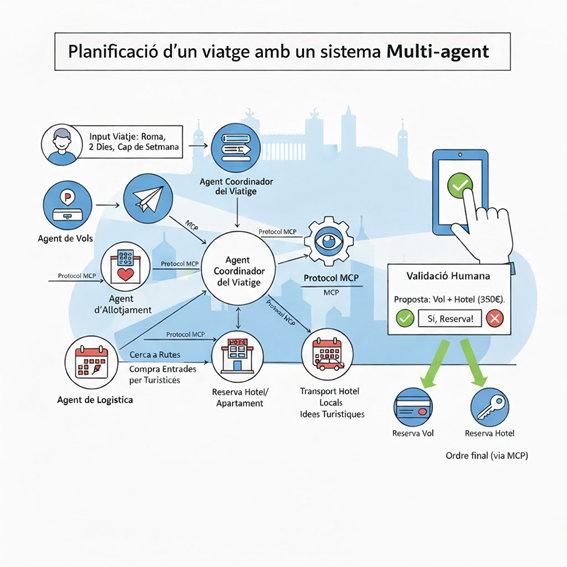
Imagine you want to go to Rome for a weekend. Instead of searching for every flight and every hotel yourselves, you activate a Multi-Agent System. Thanks to the MCP protocol, several agents start working together as a team:
Available agents:
- Flights Agent: Searches for the best combinations of schedules and prices according to your availability.
- Accommodation Agent: Searches for hotels or apartments that are close to the city center and have good reviews.
- Logistics Agent: Checks the weather and calculates travel times from the airport.
- Coordinator Agent: Receives information from the other three agents through the MCP protocol and prepares a final proposal.
The final step: the human permission
Unlike a traditional program that could make the reservation directly, a well-configured agent knows that there are critical decisions. The Coordinator would send you a message:
“I’ve found a flight arriving Friday at 7 PM and a charming hotel in Trastevere. The total budget is €350. Do you agree? If you give me your ‘OK,’ I will proceed to make the reservations.”
Only when you confirm does the agent use its tools to complete the purchase. This ability to reason, collaborate, and wait for human validation is what makes agents collaborative and safe.
What makes this connexion possible?
For our team of agents to book a hotel or a flight, they need “access gateways” to real services. This is where MCP Servers come into play. These connectors are developed and maintained both by major platforms and the open-source community. In our travel example, the accommodation agent would use the official MCP server of Booking.com or Airbnb to check prices and availability in real time. Similarly, the flights agent would connect through the MCP protocol of Google Flights or Skyscanner. These servers act as interpreters: they translate the agent’s needs into the technical language of the travel platform and vice versa, ensuring that the information is always accurate and secure.
Multi-Agent Systems represent the next step in the evolution of artificial intelligence. Thanks to communication protocols like MCP, we move from individual tools to true intelligent ecosystems capable of collaborating to achieve a goal.