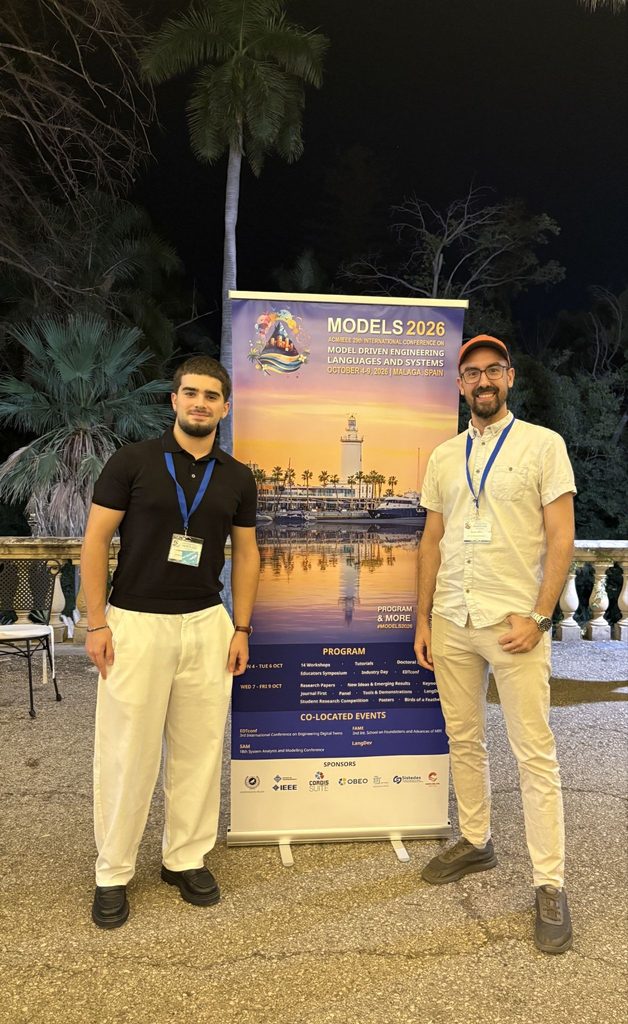
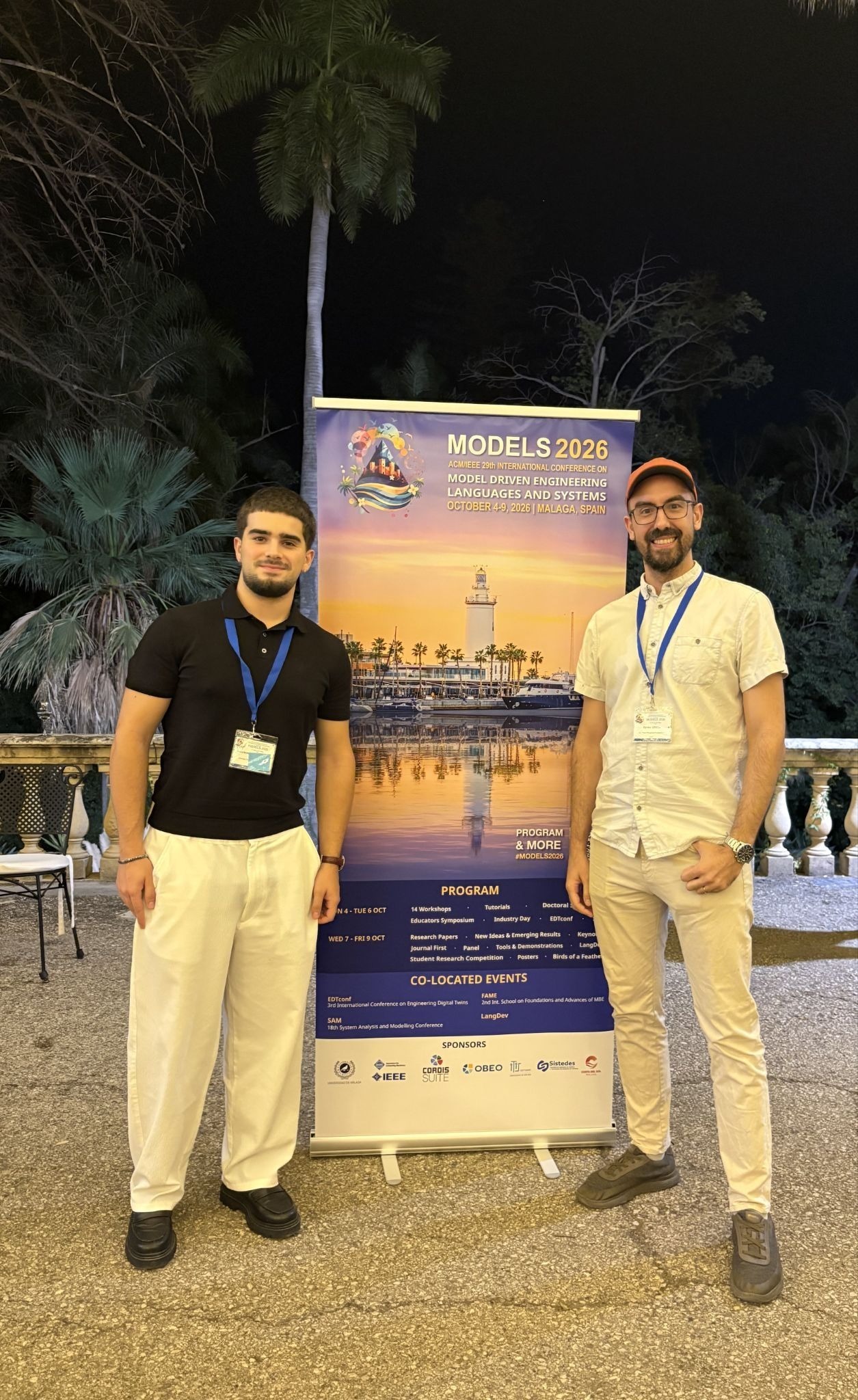
From 4 to 9 October 2026, Málaga hosted the 29th edition of MODELS (ACM/IEEE International Conference on Model-Driven Engineering Languages and Systems), one of the leading international conferences in the field of model-based software and systems engineering.
Among the most significant issues was the growing role of generative artificial intelligence and its relationship with traditional modelling techniques.
Tres perspectives sobre els reptes de l’enginyeria del programari
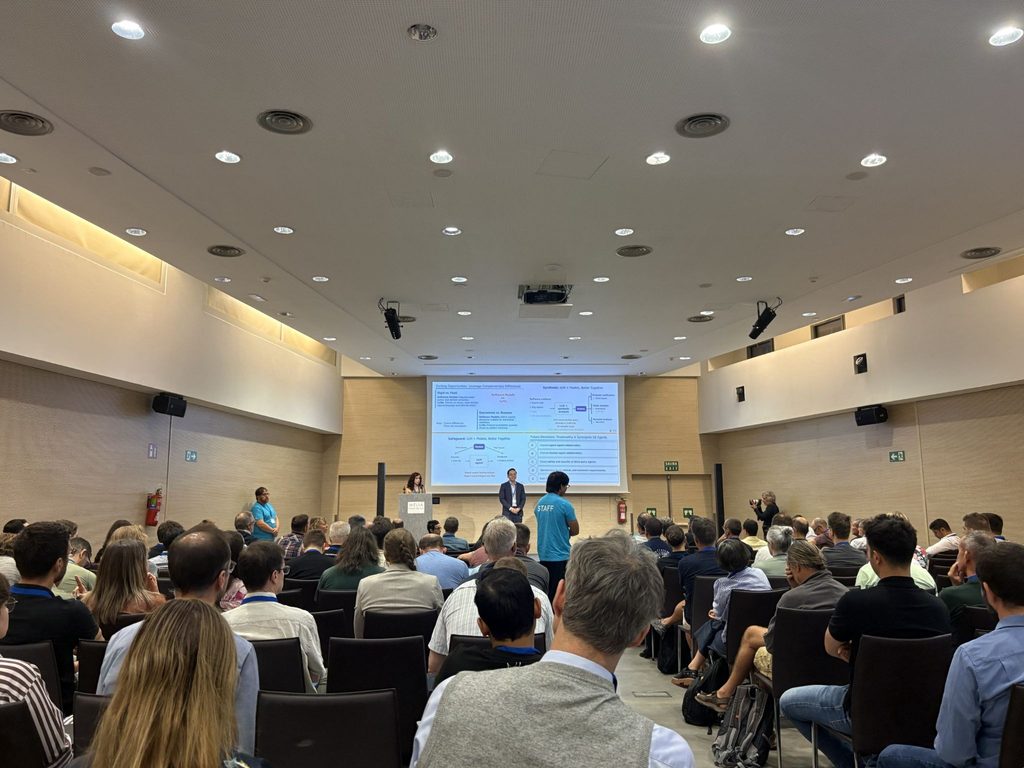
The programme included three keynote speeches by David Lo, Steven Kelly and Sira Vegas, who addressed various current and future challenges in software engineering. The talks covered topics such as the integration of artificial intelligence and formal models to mutually reinforce each other, the future of modelling in the face of technological advances, and the importance of methodological rigour in experimental research.
A space to share research and innovation
Beyond the plenary lectures, MODELS 2026 featured scientific paper presentations, workshops, tutorials and tool demonstrations, which allowed for showcasing both theoretical advances and their practical applications.
The meeting provided a space to exchange knowledge, present new solutions and establish connections between the research community and the industrial sector.
Overall, MODELS 2026 highlighted the importance of continuing to advance modelling techniques to address the challenges of an increasingly complex and AI-influenced software engineering. The combination of formal models, generative tools, and rigorous experimental methodologies opens up new opportunities to develop more reliable, understandable, and safe systems.
Our contribution: PRISMA, combining symbolic reasoning and generative artificial intelligence
In this edition of MODELS, from the inLab FIB and within the framework of the SUDOQU/RESET project, we presented the paper Generating Consistent and Realistic Model Instances with PRISMA in the Demonstrations and Tools track.
To understand the problem we are addressing, imagine we want to generate data to test an application. Symbolic reasoning tools allow us to automatically generate data that satisfy all the system’s constraints. The problem? That this data tends to be abstract and hard to understand, with values like “0”, “1” or “2”, which tell us practically nothing.
I aquí és on entra la nostra aportació. La idea és senzilla: primer, un raonador simbòlic genera les dades que satisfan totes les restriccions del model. Després, utilitzem un LLM per substituir els valors abstractes per dades més realistes i comprensibles. Així, el nostre concert «0» pot convertir-se en un concert anomenat «Autumn Rhapsody», celebrat l’1 d’abril.
But this raises an important question: how can we ensure that AI, in making the data more realistic, does not introduce errors that invalidate the original constraints? This is precisely one of PRISMA’s main contributions. Rather than blindly trusting the responses of an LLM, we use a substitution algorithm that preserves the logical consistency of the generated data.
De fet, en els experiments presentats a l’article, demanant directament a un LLM que substituís les dades abstractes, es van produir violacions de restriccions en un 37,5% de les execucions, de mitjana. Amb PRISMA, en canvi, no se’n va produir cap.
And what happens when the model’s constraints are contradictory and no solution is possible? PRISMA is also capable of identifying the constraints responsible for the contradiction and displaying them to the user, thus facilitating the detection of problems in the model.
During the conference, we presented a practical demonstration of these features, showing how generative AI and formal methods can complement each other to facilitate the understanding and validation of models.
Our participation in MODELS 2026 was a very enriching experience, which allowed us to share our work with the international scientific community, learn first-hand about the latest advances in model-driven engineering, and discover new perspectives on the integration of artificial intelligence in software development.