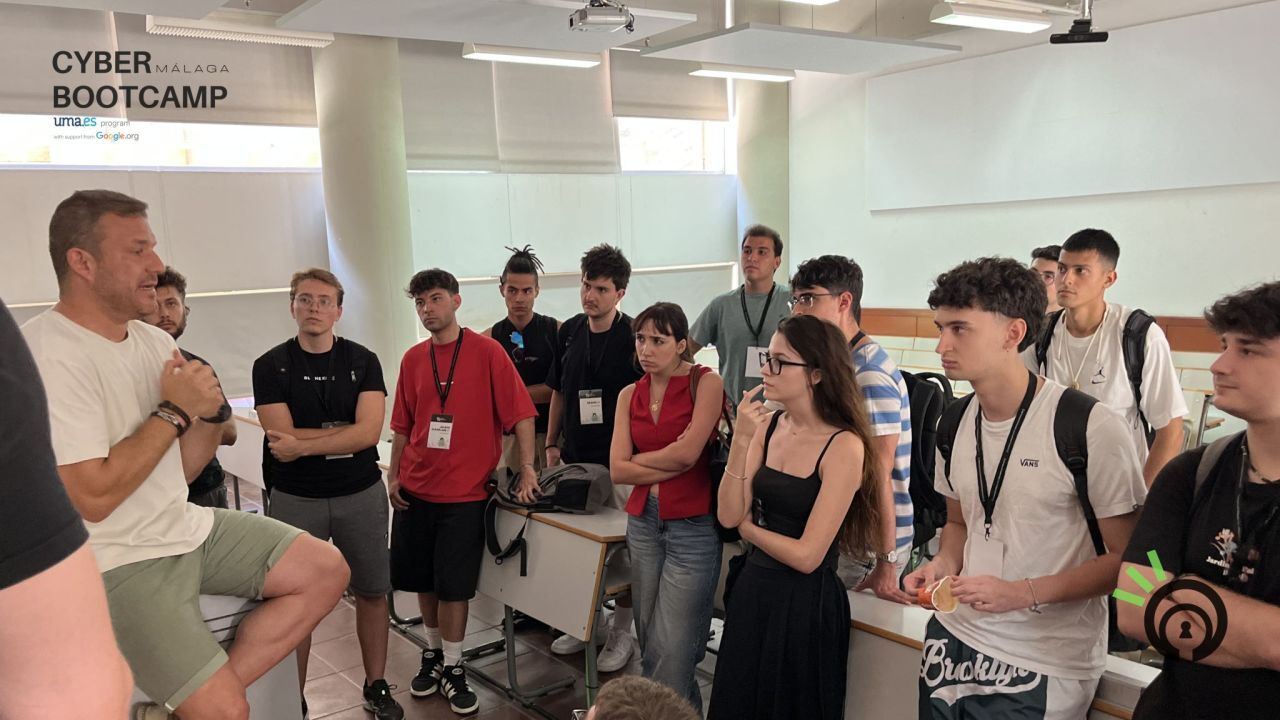
This July, I had the opportunity to take part in Cyber Bootcamp Málaga 2026, an intensive cybersecurity training programme organised by the NICS Lab research group at the University of Málaga, with the support and funding of Google.org.
The bootcamp took place in person at the School of Computer Engineering of the University of Málaga from 6 to 16 July 2026. For almost two weeks, students from universities across Spain had the opportunity to deepen their knowledge of different areas of cybersecurity, meet professionals from across the industry and put their skills into practice.
What is Cyber Bootcamp Málaga?
Cyber Bootcamp Málaga is an intensive summer programme designed to improve access to cybersecurity education and provide university students with new opportunities to develop their knowledge and skills in this field.
The 2026 edition brought together 100 students, divided into two parallel learning tracks: a basic module and an advanced module. The basic module was aimed at participants who wanted to begin their journey in cybersecurity, regardless of their academic background, while the advanced module was intended for students with previous university-level training in cybersecurity.
The programme was fully funded by Google.org, covering not only the training itself but also travel to Málaga and accommodation in a university residence close to the campus. This initiative enables students from different backgrounds and economic circumstances to access high-quality specialised training.
An intensive learning experience
I took part in the advanced module, which was attended by 50 students with previous knowledge of cybersecurity.
Each day started at 9:00 a.m. and was divided into morning and afternoon sessions. Throughout the programme, we explored a wide range of topics, including digital identity, privacy, network and systems security, cybercrime, DevSecOps, incident management, ethical hacking, web security, malware analysis, digital forensics and advanced cryptography.
We also covered emerging areas such as the security of cyber-physical systems, 5G networks, artificial intelligence applied to cybersecurity and post-quantum cryptography. This variety provided a comprehensive overview of the many disciplines that make up the cybersecurity field.
One of the aspects I appreciated most was the balance between theory and practice. The sessions went far beyond explaining concepts: they regularly included real-world case studies, live demonstrations and practical exercises that challenged us to apply what we had just learned.
University lecturers and industry professionals
Another of the bootcamp’s greatest strengths was the opportunity to learn from people with very different backgrounds and experiences. The sessions were delivered by both lecturers from several Spanish universities and professionals from companies and institutions specialising in cybersecurity.
This allowed us to gain a wide range of perspectives, from academic research to incident response, malware analysis, cyber threat intelligence and penetration testing.
Beyond the technical knowledge, many of the sessions also encouraged us to reflect on the importance of collaboration, continuous learning and the responsibility we have as cybersecurity professionals when working with sensitive systems and information.
The Advanced Module CTF
One of the activities I enjoyed the most was the Capture The Flag (CTF) competition held as part of the advanced module.
A CTF is a cybersecurity competition made up of a series of challenges in which participants must identify vulnerabilities, analyse files, investigate network captures, solve cryptography problems or exploit applications specifically designed for the competition. Each challenge contains a hidden flag that must be obtained using the appropriate knowledge, techniques and tools.
It was an intense but incredibly enjoyable experience. It gave us the opportunity to apply many of the concepts we had been working on throughout the bootcamp and tackle problems that required research, persistence and trying different approaches when the first solution did not work.
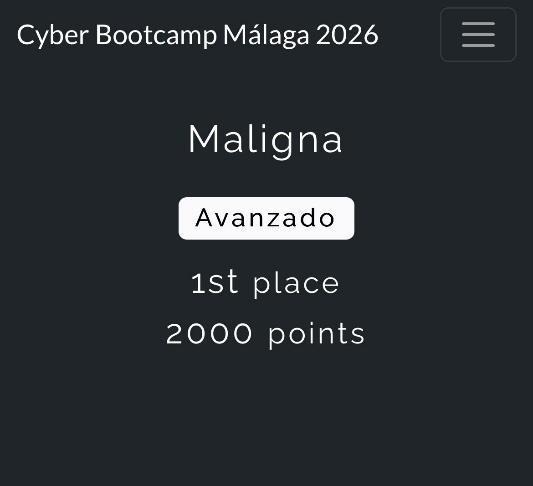
In the end, I was awarded first place in the Advanced Module CTF, an achievement that I am particularly proud of. More than the final ranking itself, the competition was an excellent way to put everything I had learned during those two weeks into practice and to see how much I had progressed.
Visit to the Google Safety Engineering Center
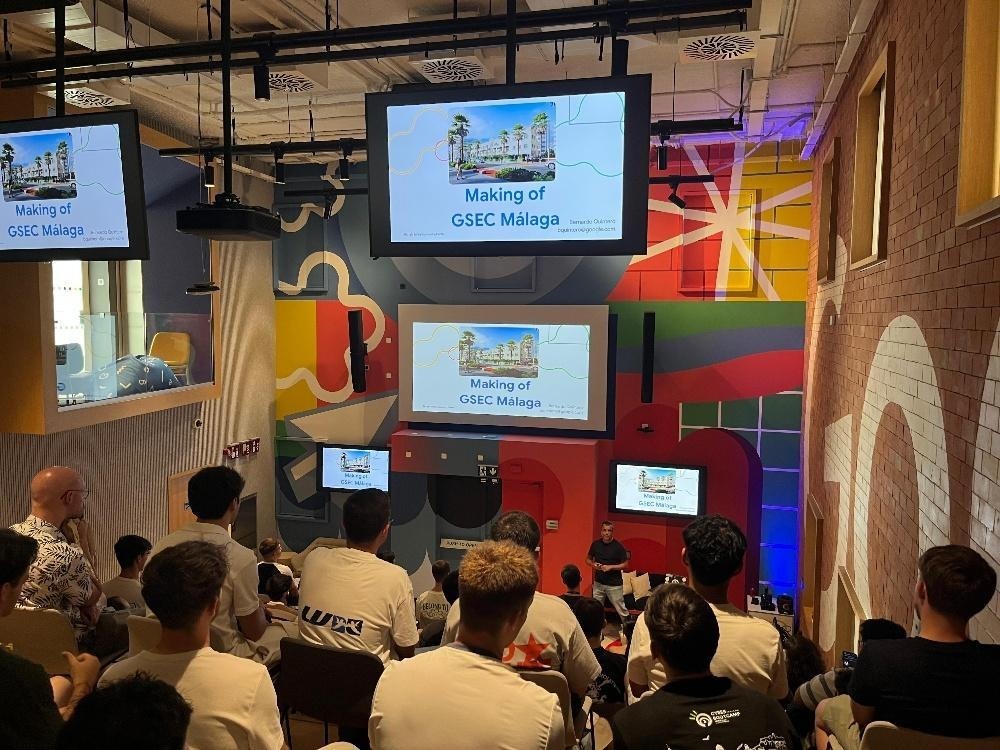
One of the highlights of the bootcamp was our visit to the Google Safety Engineering Center (GSEC) in Málaga, Google’s main cybersecurity centre in Europe.
The centre is home to teams specialising in threat intelligence, incident detection and response, and the development of cybersecurity tools. It also hosts teams working on projects such as VirusTotal and Google Security Operations.
During the visit, we had the opportunity to tour the offices and gain a better understanding of how the different teams work. We also attended a talk by Bernardo Quintero, founder of VirusTotal, who shared the story of how he first became interested in computing and cybersecurity, his professional journey, and how the project that would eventually become VirusTotal was created before later being acquired by Google.
It was an inspiring and genuinely personal talk. Rather than focusing only on his achievements, he spoke about the process behind them: the doubts, the challenges and the curiosity that motivated him to keep learning and building new projects. Listening to his story in the very place where some of Google’s leading cybersecurity teams now work made the experience particularly memorable.
Beyond the classroom
Cyber Bootcamp was much more than a technical training programme. Spending almost two weeks living alongside people who share the same passion for cybersecurity created countless opportunities to exchange experiences, tools, projects and different ways of approaching technical challenges.
Some of the most valuable moments took place outside the classroom: conversations between sessions, evenings at the student residence and the many hours spent discussing the challenges we had solved. Bringing together students from different universities and backgrounds created a highly motivating environment where everyone could learn from one another.
The programme also extends beyond the time spent in Málaga. Every participant is required to develop an outreach plan to share the knowledge acquired with an organisation or community in their own environment through activities such as workshops, seminars or awareness talks. In this way, the impact of the programme reaches far beyond the students selected to take part.
An experience I would definitely repeat
Taking part in Cyber Bootcamp Málaga has been an incredibly rewarding experience, both academically and personally.
It allowed me to deepen my knowledge of areas of cybersecurity that I was already familiar with, discover new ones, challenge my skills and meet students and professionals who share the same passion for this field.
I returned from Málaga with a great deal of new knowledge, valuable professional connections and, above all, even greater motivation to continue learning and developing my career in cybersecurity. Finishing the programme by achieving first place in the Advanced Module CTF was the perfect ending to two unforgettable weeks that I am sure I will remember for a long time.